
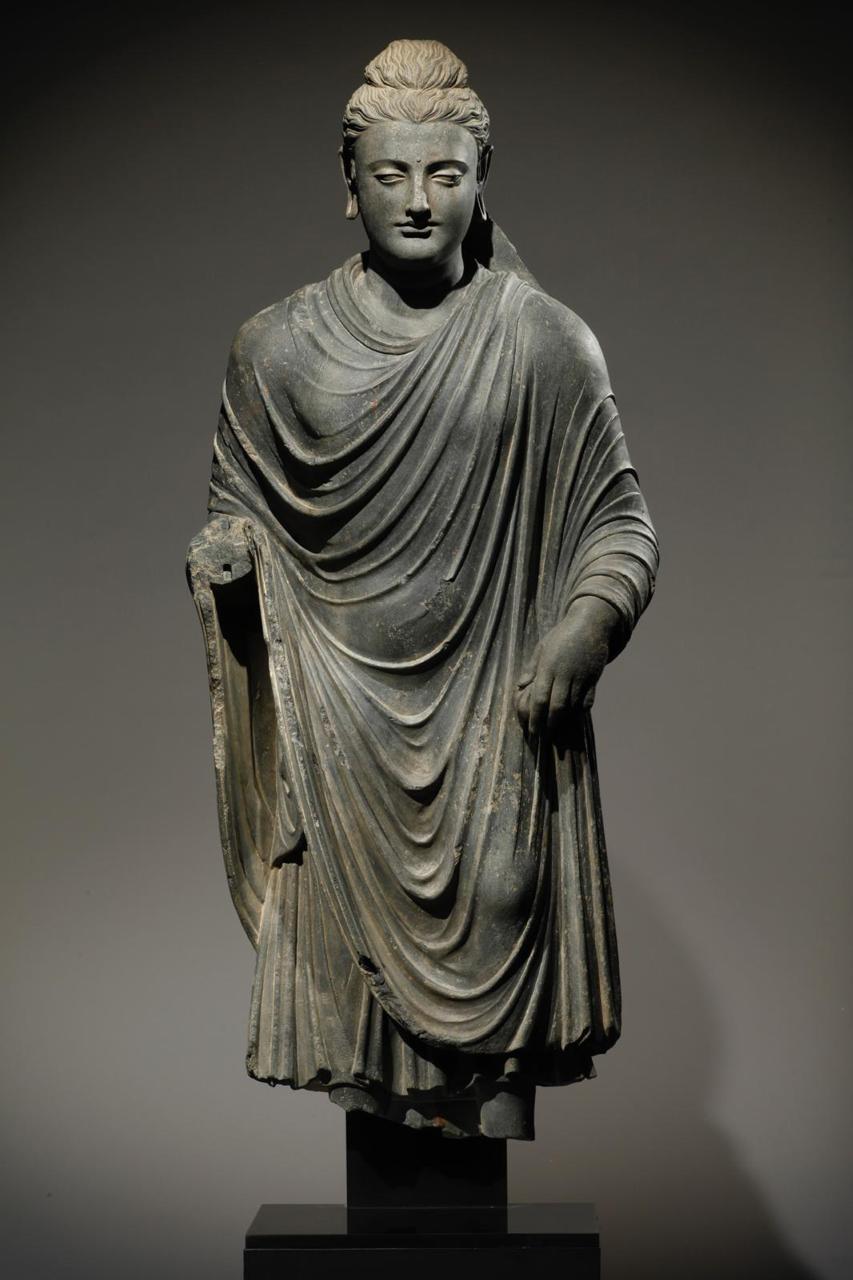
Osmund Bopearachchi, When West Met East: Gandhäran Art Revisited, Volume I (Manohar, 2020), cat.no. 150
Osmund Bopearachchi, When West Met East: Gandhäran Art Revisited, Volume II (Manohar, 2020), p.358-359
Stylistically this statue of the Buddha (Cat. No. 150) has the same basic features as the previous Buddha image which is in perfect condition (Cat. No. 149). Unfortunately, the halo, part of the right forearm and the lower part of the body a little below the knees and the base are broken. Presumably, the lower part of the right forearm was fixed separately to the remaining part of the hand as indicated by the dovetail mortise. On the previous sculpture, the Buddha holds the hem of the samghāti with the left arm turned towards the viewer showing the palm (Cat. No. 149), while on the present statue the hem is held showing the back of the hand to the viewer. The neckline of the over-robe has a clearly distinguishable back-throw, though the ridges are less pronounced. Compared to the previous sculpture (Cat. No. 149)the effect of the tight drapery is even more accentuated especially on the shoulders, breasts, abdomen and left knee. The locks of the hair undulate densely like waves towards the usnisa. The thin twisted band at the base of the usnisa is not marked explicitly. As on the previous sculpture, the short projecting ears are slightly concave and the lobes are grooved. The head and very particularly the eyes are angled downwards. The half-open eyes are slightly protruding; the lower edges of the upper lids curve in harmony with the gently curving eyebrows.

