
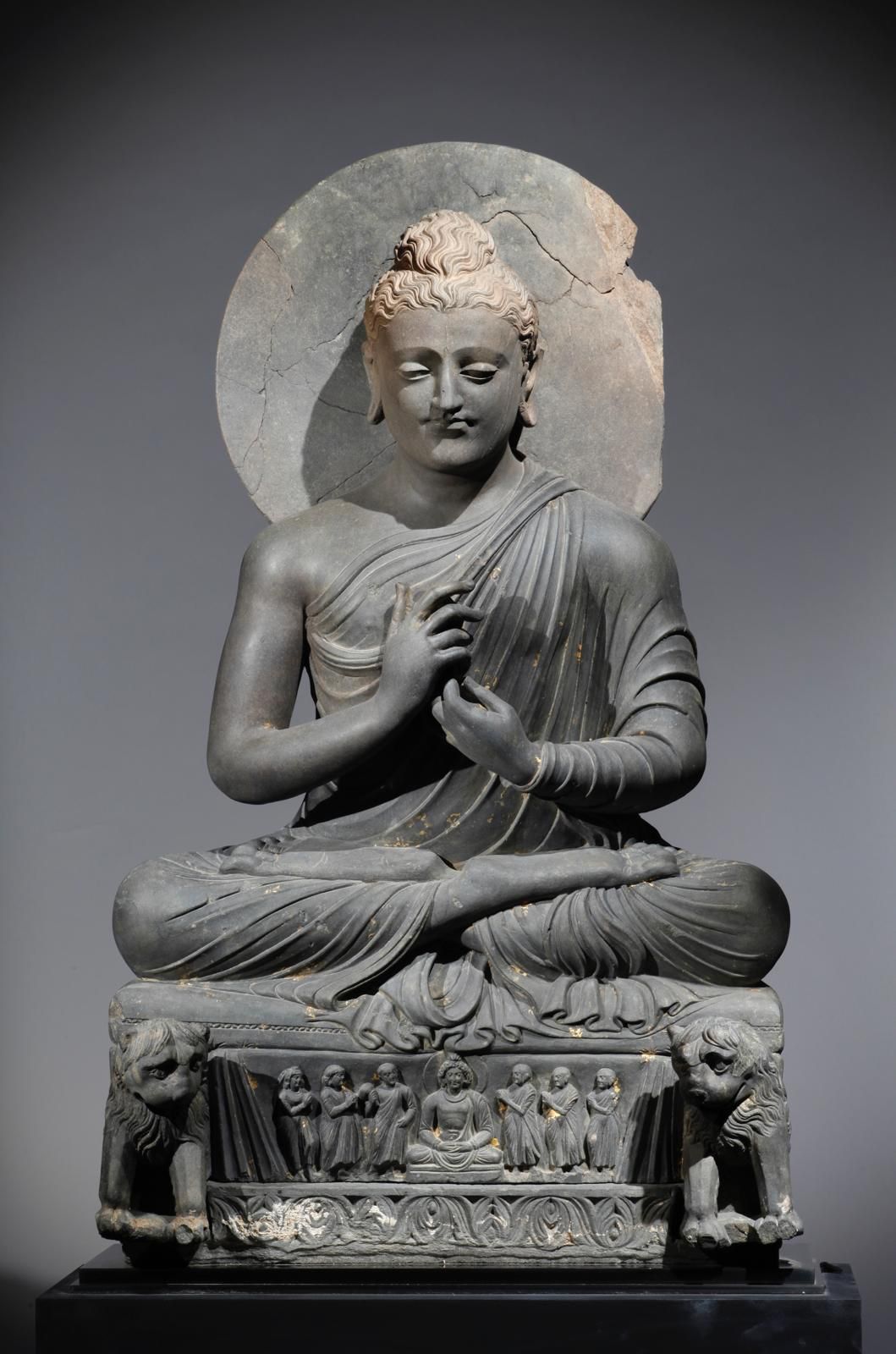
Osmund Bopearachchi, When West Met East: Gandhäran Art Revisited, Volume I (Manohar, 2020), cat. no. 155
Osmund Bopearachchi, When West Met East: Gandhäran Art Revisited, Volume II (Manohar, 2020), p.365-366
The Buddha seated in lotus position (cross-legged) makes the dharmacakra mudra, the setting into motion of the wheel of the dharma. The samghäti (over-robe) in high relief is worn across the chest, exposing the right shoulder and a part of the uttaräsänga (upper-under-robe) with low drapery folds. The drapery of the samghāti has high and rounded edges and is gathered at the wrist of the left arm. The head, centred in a circular, partly damaged, halo, is oval with strands of hair undulating from the peak of a sharp raised hairline into the usnisa. The facial features are regular and the forehead is low. The narrow rounded eyes, with low lids below the eyebrows marked in low relief, slant downwards. The circular ürna is in low relief well above the nose. The flat nose is straight over a pursed mouth shaped with a discrete suggestion of a moustache indicated by a small convexity on both sides. The concave ears are relatively long with a groove in each lobe. All the fingers and the thumb of the lower left hand touch the bottom of the upper right hand making the dharmacakra mudrä. The hands have straight thumbs and supple fingers with nails. On the seat of the Buddha, a cushion with slight depression in the centre is decorated with a horizontal line of undulating leaf-pattern. In the place of the usual legs in the form of the paws of a lion (cf. Zwalf, 1996, figs. 24 and 26), this sculpture has two extensions composed of the forepart of a lion. The lions stand with their heads turned towards the central scene of the base. On the upper base, below the cushion, framed by drapery that covers the seat and is pulled to the sides, a Bodhisattva sits in dhyanamudrä wearing an uttariva draped around his upper left arm, leaving the right shoulder bare. The uttariya reappears from behind his back over the elbow of the right arm and falls over his feet in a semi-circular shape. The head is round and the halo plain; the treatment of the hair with curly tresses reminds us of the sculpture of the Bodhisattva in the present catalogue, Cat. No. 159. The Bodhisattva as usual wears a short flat band necklace and raised-edged bracelets. In spite of the absence of the flask, he has many features similar to the Bodhisattva Maitreya holding the flask depicted on the base of the sculpture now in the National Museum of Scotland (Cat. No. 164). He could indeed be Maitreya making the link with the Buddha Gautama seated above. The lower base is decorated with rows of alternating vertical and reverse stylised acanthus leaves like those on the base of the fasting Siddhartha (Cat. No. 103). To the left of the seated Bodhisattva, three monks dressed in samghati leaving the right shoulder bare stand turning towards the Noble Being in añialimudra. To the right, two female worshippers wearing lavish garments and jewellery stand turned towards the Bodhisattva in añjalimudra while a monk stands holding a fly-whisk. This is the most impressive and well-preserved sculpture of a seated Buddha in dharmacakra mudra known so far in Gandhāra, although it has many stylistic similarities with the partly damaged seated Buddha from the former G.A. Dale collection now in the British Museum (Zwalf, 1996, fig. 25).

