
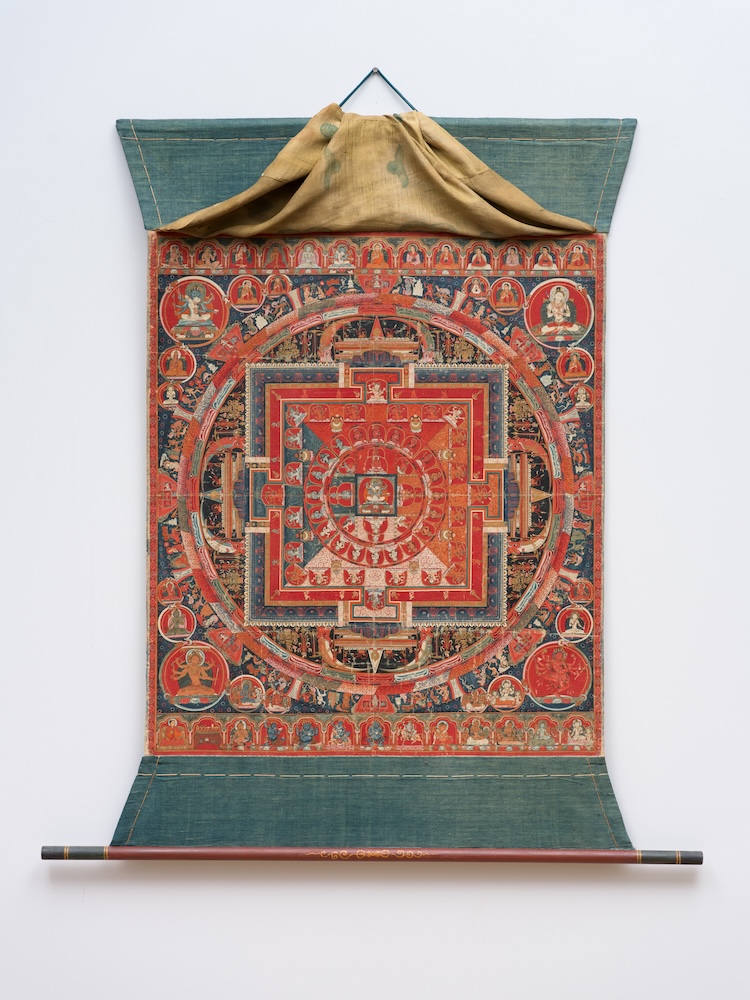
Galerie Robert Burawoy, Peinture du Monastere Nor, 1978
This mandala features three circles of deities surrounding the central figure. It is described in the NSP 14.At the center of the mandala, seated on a lion-adorned throne, is Yogāmbara embracing his Prajñā, Jñanadākinī. The first circle consists of twelve goddesses (who also appear in the Jñanadākinī mandala): two goddesses of the same color at each of the four cardinal points, and one bicolored goddess at each of the intermediate points.The second circle is composed of 20 deities. At the four cardinal points, each deity appears to be repeated three times (Pukkasī, Ghorī, Ugrī, Kapālī); at the four intermediate points are the eight goddesses of the cult (four goddesses of offerings and four goddesses of homage—note that here, Vīnā replaces Mālā).According to Mlle de Mallmann (IITB p. 470), the tripling of the four goddesses is a device used by the artist to achieve the number of figures prescribed by the text. This is not the case; indeed, while NSP 14 is silent on the matter, NTMP 12/14 specifies that the Sanskrit text of the NSP indicates elsewhere that a single name represents a group of three deities—"Pukkasī and others"—whereas the Tibetan translation distinguishes between them:Pukkasī: Pukka sī | Dā mi dā | Gtun mo
Ghorī: Jigs byed ma | Grags ma | Ša ma
Ugrī: Drag śul ma | Bar ma | Mi sdug ma
Kapālī: Thod pa ma | Rdo rǰe ma | Bum pa ma
The outer circle features 8 Hindu deities (4 major gods in the gateways and 4 Dikpālas in the corners) and 16 Shaivite deities in the galleries.
In the upper gallery, positioned between the Indian masters of the Madhyamika school (including the founder Nāgārjuna) on the left and the Tibetan Lamas on the right, one finds Vajradhara (the Ādibuddha of the Sakya school) embracing Jñanadākinī; in the southwest corner, Vajrasattva and Jñanadākinī (another form of Vajradhara); and in the southeast corner, two forms of Jñanadākinī alone. Eight Hindu deities appear in the southeast and northeast corners as well as in the lower gallery. Regarding the Hindu deity in the lower gallery whom I have tentatively identified as Yama—this is merely a supposition. Indeed, the Tibetan name does not correspond to any deity listed in the NSP, and the mount (a horse) does not match; however, errors of this kind are common among artists or likely arise during the translation of texts. Nevertheless, the color, attributes, and association with the other three Dikpālas identify this figure as Yama.
The mandala is surrounded by the eight charnel grounds, but the Hindu deities presiding over them are replaced by small mandalas.

