
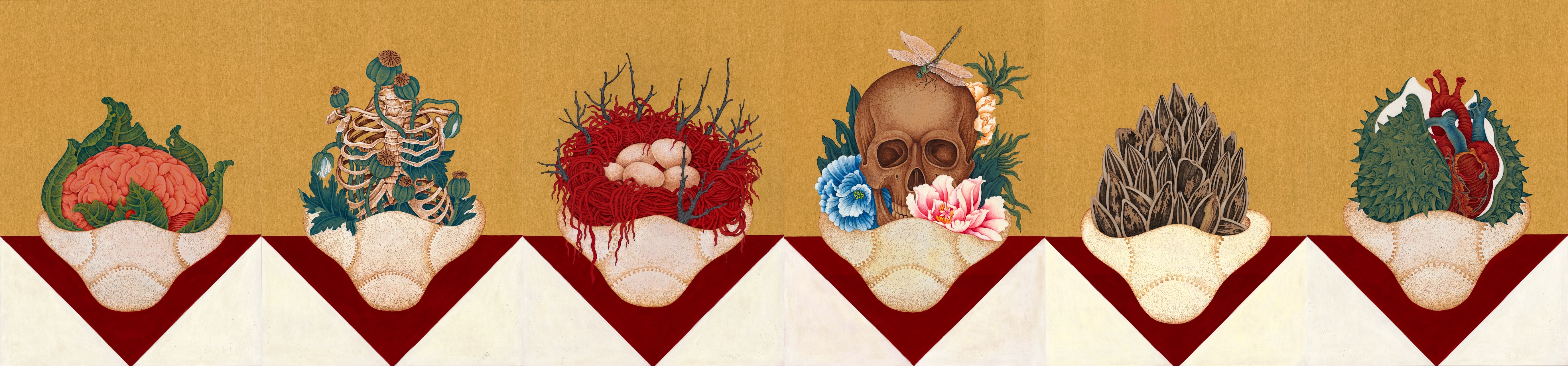
The work constructs an independent ritual field in the form of a six-panel polyptych. The unified gold-leaf ground, the red-and-white inverted-V geometric pattern, and the uniform kapala bowls (skull cups) at the bottom together constitute a communion table that bears both body and spirit. There are no traditional apostles in the painting; instead, six motifs, namely, a brain, ribs, a bird’s nest (with eggs/red threads), a skull, a cluster of pointed leaves, and a heart, serve as a metaphor for a spiritual variations in six parts, transforming the religious Last Supper into an anatomy on the essence of life. The feast is thus turned into a sacrifice.
